
Why Ice Dams Form (and How to Stop Them) in Baltimore County
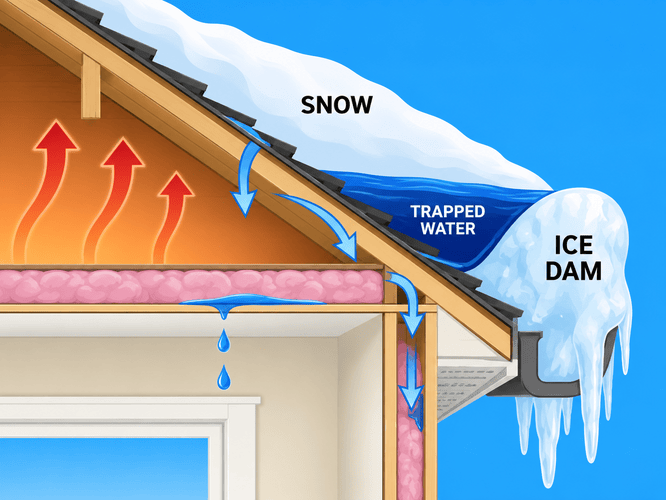
Icicles along the gutters look harmless, right up until a brown water stain blooms on your ceiling in February. If that sounds familiar, the problem probably isn’t your shingles; it’s your attic.
Freeze-thaw cycles make ice dams a recurring winter headache for homeowners in Timonium, Lutherville, and surrounding areas. If an ice dam has already caused damage, professional roof repair in Baltimore County can help address the problem before it gets worse. Here’s what’s actually happening and how to fix it for good.
What an Ice Dam Is (and Why It Forms)
Snow on your roof should melt slowly and evenly. But when heat escapes into your attic, it warms the roof deck from below. Snow melts near the peak, runs down, and refreezes when it hits the cold eaves. That ridge of ice, the dam, traps the meltwater behind it, and the water backs up under your shingles, soaking the decking and finding its way inside.
The Real Culprits: Ventilation, Insulation, and Air Leaks
Three conditions create ice dams, and most homes have at least one:
- Inadequate Ventilation: Heat trapped under the roof deck has nowhere to go. Ridge vents and soffit vents work as intake and exhaust; if either side is missing or blocked, the system fails.
- Insufficient Insulation: Heat rising from your living space into the attic melts snow from below.
- Air Leaks: Recessed lights, attic hatches, and bathroom exhaust fans venting into the attic instead of outside all pump warm, moist air where it doesn’t belong.
This is why a quality roof is a system, not a shingle swap. Proper underlayment, ice and water barriers at the eaves, and balanced ventilation work together: the same complete-system approach behind the CertainTeed and GAF products we install.
Warning Signs Your Home Has an Ice Dam
Knowing the warning signs can help you catch an ice dam before it causes more serious damage.
- Outside
Look for uniform icicles along the eaves (not just on the gutters), ice buildup filling the gutter line, or damaged shingle edges where ice has pried them up.
- Inside
Check for water stains on ceilings or exterior walls in winter, peeling paint near the tops of walls, or a musty smell in the attic after a thaw: that’s moisture, and possibly mold, setting in.
A water stain on your ceiling is an early warning sign worth acting on immediately, not a “wait until spring” item.
What Homeowners Can Do Themselves
- Clean your gutters before winter. Blocked gutters give meltwater nowhere to drain, accelerating ice buildup.
- Seal visible air leaks around attic penetrations, hatches, and light fixtures.
- Check insulation depth against Department of Energy recommendations for your climate zone.
Do not chip ice off the shingles (you’ll damage them), salt the roof (it corrodes metal and degrades shingles), or climb onto an icy roof at all.
When to Call a Professional
If ice dams keep coming back, the fix is structural, and it’s worth doing right. This includes:
- Ventilation Corrections: Adding ridge or soffit vents and baffles to restore airflow.
- Ice and Water Barriers: Self-sealing membranes at the eaves, a standard practice in our installations.
- Insulation and Exhaust Upgrades: Rerouting bathroom fans and sealing the attic floor.
- Damage Assessment: Performing thorough leak detection to find intrusion at its source and checking whether decking and shingles survived the season.
Need Roof Repair in Baltimore County? Contact Homelife Roofing & Remodeling
For Baltimore County homeowners, recurring ice dams can eventually lead to damage that requires professional roof repair. At Homelife Roofing & Remodeling, we can assess the source of the problem and help address the underlying roofing and ventilation issues. We don’t ask for payment until the job is complete and done right, and our lifetime labor warranties match lifetime product warranties.
Simply request an estimate online or contact us at (410) 864-0178 to schedule your free consultation.